
Intelligent Compressed Air Storage System For Manufacturing Facilities With Intermittent Demand Of Compressed Air
Compressed air systems are vital in manufacturing but are highly energy-intensive due to inefficiencies like leaks, improper usage, and oversizing. This research introduces an intelligent compressed air storage system featuring a flow control system, optimized reserve tank sizing, and an advanced detection system to reduce leaks and energy consumption during downtimes while ensuring operational stability. Lab-scale and industrial-scale simulations demonstrate significant energy savings, with minimal impact from reserve tank volume changes on energy use but a notable influence on recovery time. Combining the system with strategies such as leak reduction or lower downtime pressure further enhances savings, with flow switch and filtered pressure derivative methods proving the most reliable for detection. The system’s scalability and adaptability make it a practical solution for improving energy efficiency and reliability in compressed air systems, addressing key challenges in sustainable manufacturing


*U.S. Census Bureau, “Electricity demand by U.S. manufacturing has declined in recent years,” 2018, https://www.eia.gov/todayinenergy/detail.php?id=35472#, accessed on 06/28/2021
**U.S. Department of Energy, “Energy Tips – Compressed Air,” 2004, https://www.energy.gov/eere/amo/articles/minimize-compressed-air-leaks, accessed on 06/28/2021
It is estimated that about 900 million megawatt-hours of electricity is consumed by the manufacturing facilities in the U.S. 10% of the consumed energy is used for producing compressed air. 20-30% of this portion is simply lost through leaks in the compressed air system. As a result, the amount of energy lost is estimated to be 18-27 MWh every year, which is a significant and avoidable waste. Compressed air is considered one the most expensive industrial energy source as its unit cost for production is more than twice of that of electricity, steam, and natural gas.
Energy audits conducted by the Industrial Assessment Center (IAC) at Texas A&M University reveal that many manufacturing facilities use compressed air primarily during production hours, with significantly reduced usage during non-production periods.
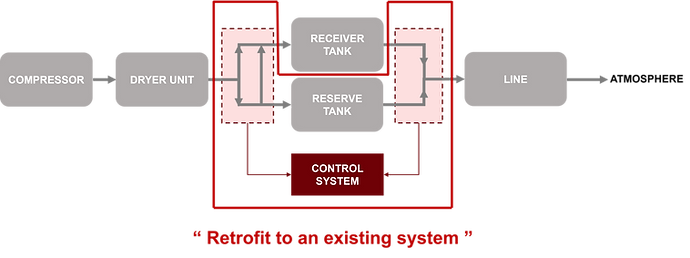
This research proposes an intelligent compressed air storage system to address such intermittent demand. By reducing pressure in the main storage tank (Receiver) and line volumes during downtime and utilizing a reserve tank to supply air during sudden demand, the system lowers compressor operation frequency and leak rates, enhancing energy efficiency

Developing an intelligent compressed air storage system requires designing the flow control mechanism for the compressed air, appropriately sizing the reserve tank to optimize the installation cost and devising a detection system to accurately and rapidly distinguish periods of production and non-production in a manufacturing facility.
01
Control System Development

To achieve the objectives of the intelligent compressed air storage system, a series of logical steps are followed to determine how to regulate the airflow between its significant volumetric components, including the compressor, the receiver tank, the reserve tank, and the line volume.

There are four important modes that the system operates in: “Normal,” “Start-up,” “Non-production,” and “Recharge” modes. Notably, the “Cold start-up” mode from is omitted, as it is a relatively infrequent occurrence in manufacturing facilities, predominantly due to the common practice of maintaining the compressor on all the time. In "Normal" mode, consistent demand keeps the system at operational pressure, while "Non-production" mode lowers line and receiver pressure during downtime to save energy, despite some leakage. "Recharge" mode prepares for downtime by pressurizing the reserve tank, and "Start-up" mode uses the reserve tank to quickly restore operational pressure, allowing the compressor to repressurize to operational level.

Lab-scale experimental setup is developed based on components such as solenoid valves, a power transducer, pressure transducers, a flow switch, and a motorized ball valve, are controlled by a DAQ device through the Simulink software in the computer.

Key control states—“Normal,” “Non-production,” “Recharge,” and “Start-up” modes—are validated through experiments. The observed pressure behaviors confirm effective compressed air distribution aligned with the predefined control states
02
Sizing Of The Reserve Tank In The System
The sizing of the reserve tank in the proposed system plays a crucial role in optimizing both the energy savings and the initial installation cost. To analyze different scenarios, simulation testbeds were created. Unlike the experimental setup, where a motorized ball valve emulates demand and leaks, the simulation model incorporates direct input of demand and leak profiles.

To conduct analysis on each component of the system, pressure at each component of the proposed system and mass flow rates passing through each valve are calculated.

The simulation model outputs the compressor’s energy consumption during the observed period and the average recovery time necessary for a line volume to attain operational pressure following a period of non-production mode.

A lab-scale simulation was calibrated using real-world data from a lab-scale testbed, while industrial-scale simulations were designed based on actual data from manufacturing facilities and relevant assumptions. Results show the proposed system reduces energy consumption. Reserve tank volume minimally affects energy savings (<1%) but affects recovery time, requiring careful sizing. According to the cost analysis, combining the system with leak reduction and downtime pressure management achieves energy savings between manual compressor shutdown and conventional systems.


03
Detection System Development


The detection system in this research offers an affordable, easy-to-install solution for existing manufacturing facilities to recognize changes in air usage, requiring minimal initial knowledge for implementation. The detection system utilizes sensors, including a power transducer, pressure transducer, and flow switch.
Flow switch: A flow switch can be used to detect the availability of the demand. By utilizing the thresholds established for the flow rate that corresponds to the demand state, the system can automatically differentiate between periods of compressed air demand and non-demand.
Pressure difference with a filter: Pressure in the line of the compressed air system decays either due to leaks or the production usage. The decay rate of the line pressure during the production period is steeper than during the non-production period, because more air is being consumed. Therefore, comparison of the decay rate helps identify transitions between production and non-production periods. In this study, the average difference of pressure and derivative of pressure are considered for the decay rate.
Pattern search method: It utilizes a moving window on the line pressure signal in real-time. Reference signals are compared simultaneously with the moving window using the Pearson correlation coefficient. The current reference signals are generated from line pressure signals during the production, non-production, and start-up modes in the past experiments.
[*Wikipedia, “Pearson correlation coefficient,” https://en.wikipedia.org/wiki/Pearson_correlation_coefficient]
Cyclic behavior-based methods: Pressure and power consumption of a compressor oscillate in a compressed air system because the compressor constantly turns on and off to meet its setpoint. Due to the pattern of oscillation, a cyclic behavior of pressure and power consumption emerges which is reflected. The duty cycle can be calculated by dividing the rise time in a cycle with the cycle period. Since compressed air is consumed more during the production period than during the downtime period, the duty cycle would be higher than that of the non-production hours. The difference between the duty cycle during the production and that of the non-production periods allows the proposed system to detect the change of air consumption in the system.
Example analysis of the flow switch method: The overall detection time and the delay time for the detection with the flow switch is observed to be 3.7 [s] and 3.5 [s] respectively. Beside the pattern search method, the flow switch is the fastest method to detect the change of demand. Also, due to the simple design of the method, the accuracy of the detection is higher than the other methods. The only downside is that the flow switch may be more expensive than the other sensors for detection.
The table on the left explains the trade-off between detection time and sensor cost, with flow switch and filtered pressure derivative methods achieving reliable detection within 10 seconds, minimizing production disruptions. While the pattern search method offers fast detection, its accuracy depends heavily on reference signal quality, highlighting the need for more reliable alternatives.
04
Demonstration Of The Assembled Intelligent Compressed Air Storage System
The assembled intelligent compressed air storage system is demonstrated using various detection methods to evaluate their effectiveness across operation modes. The flow switch and filtered pressure derivative methods prove highly reliable, offering quick detection and enabling energy savings without disrupting production.


Increased compressor capacity (from 3 [hp] to 60 [hp]) improved detection and recovery times, with the flow switch and filtered pressure derivative methods maintaining reliability, while the cyclic behavior-based method showed reduced detection time but remained unreliable for brief non-production periods.


